Islamic Revolution Leader, Ayatollah Sayyed Ali Khamenei in the Imam Reza (AS) holy shrine elaborated the Islamic System’s achievements during the past thirty years and said
“The country needs two important platforms including progress and justice to enter the Islamic Revolution’s fourth decade.
The prerequisite for progress alongside justice is that all officials should consider themselves duty bound in using innovation and carry out all projects and which have started since last years or recent years in 1387,” the IR Leader said. “The victory of the Islamic Revolution in Iran break the false division of hegemonic and subduable countries and the Islamic system announced clearly that was against hegemonic attitudes,” he added.
Pointing that the Islamic system has resisted against hegemonic powers during the last 30 years which have changed the equations in the Middle East in favor of the Islamic system, Ayatollah Khamenei said “The Middle East which was an arena for American administration’s show of power, now it has changed into a scene for America’s defeats.”
“The enemy during the last 30 years posed different plots including the imposed war, economic sanctions and psycological war but the Islamic system sttod firmly against them and increased its power more than before and nowadays the Islamic Revolution’s message have been deep-rooted.”Pointing to the regional and world nations’ love of the Islamic Revolution, the IR Leader said “IRI’s progress in scientific, technologic and socials fiels has lead to expansion of the Islamic Revolution’s message.”
“The Islamic system on the thershold of entering the fourth decade should move with an speed more than normal and make up for backwardness.”“Justice without progress would result in poverty and progress without justice would not be in favor of the country because the class gap must be reduced and all people should gain equal opportunities for work and production,” he said.“The people demand should be lead to progress, increase in productivity, national unity, scientific achievements, spirituality, reducingthe calss gap, public welfare, political improvement and national self-confidence. These issue would just be gained through justice.
Friday, June 20, 2008

Wednesday, May 28, 2008
Rat meat new delicacy in TN villages
There is a new delicacy that is in hot demand in hamlets in Tamil Nadu and Puducherry - protein rich rat meat. It comes cheap, just Rs 2.50 per rat, and villagers swear nothing tastes better.
Snake-hunting Irula tribals, desperate to peddle their rodent-snaring skills, have succeeded in getting the meat on the kitchen menu of villages in Cuddalore district and the Union Territory. The trend could catch on elsewhere too.
Baskar (29) hailing from Melazhunjipettu, Cuddalore district in Tamil Nadu, is hooked to the new found delicacy.
"It (rat meat) tastes so good. I think those who taste it once will start eating it regularly. All our family members eat rat meat now," he said.
Competing with the villagers are the arrack and toddy shop owners. The potent brew and cheap meat are a big hit among villagers. The paddy fields are the tribals’ hunting ground. Each tribal hunter catch about 15 rats a day from the fields and divide their catch among villagers, arrack and toddy shop owners and save a few to take back home.
Original Post : http://timesofindia.indiatimes.com/Heads_and_Tales/Rat_meat_new_delicacy_in_TN_villages/articleshow/3072086.cms
Snake-hunting Irula tribals, desperate to peddle their rodent-snaring skills, have succeeded in getting the meat on the kitchen menu of villages in Cuddalore district and the Union Territory. The trend could catch on elsewhere too.
Baskar (29) hailing from Melazhunjipettu, Cuddalore district in Tamil Nadu, is hooked to the new found delicacy.
"It (rat meat) tastes so good. I think those who taste it once will start eating it regularly. All our family members eat rat meat now," he said.
Competing with the villagers are the arrack and toddy shop owners. The potent brew and cheap meat are a big hit among villagers. The paddy fields are the tribals’ hunting ground. Each tribal hunter catch about 15 rats a day from the fields and divide their catch among villagers, arrack and toddy shop owners and save a few to take back home.
Original Post : http://timesofindia.indiatimes.com/Heads_and_Tales/Rat_meat_new_delicacy_in_TN_villages/articleshow/3072086.cms
Australian town rejects Muslim school
Australian authorities rejected the development of a 1,200-student Islamic school on the outskirts of Sydney on Tuesday, saying it was inappropriate for the small town where anti-Muslim protesters opposed the school.
Camden Council voted against the school being built based on concerns over the impact on traffic flows, loss of agricultural land, but not on religious grounds.
"It is a site issue ... we said all along religious issues, nationalistic issues, will not be entered into," Mayor Chris Patterson told local media.
The school was planned for Muslim students and would have taught the standard Australian education program but also conducted religious classes just as Catholic and Anglican schools in Australia do.
|
|
Why European cos fear Google!
Executives from across Europe's technology, media and telecoms sector fear Internet search and advertising giant Google may steal their business, they told a Reuters summit this week.
Several managers cited the Silicon Valley-based company as one of their most feared rivals -- even if they did not know exactly how Google would become their competitor -- and one they should try to partner with if they knew what was good for them.
More Internet InsightsWhite PapersBuilding an Online Customer Experience Competency: Five Steps The 9 Noble Truths of Custom Experience: Website Wisdom for Everyone in the Organization "I am worried about Google, just because I don't know," Eric Simonsen, chief financial officer of telecoms infrastructure provider Nokia Siemens Networks, told the Reuters Technology, Media and Telecoms Summit in Paris.
"Our vision, with the world connected, primarily over the Internet, 5 billion people, and you look at the economic resources that Google has -- if I think they are not going there, that's a pretty stupid assumption on my part," he said.
"I have no idea how, I have no idea when, but I ought to be thinking about those kinds of things."
Google has branched out from its core businesses into areas as diverse as cellphone software, submarine communications cables and medical software, raising a wave of anxiety that has spread from the United States and is still rising in Europe.
In the US, companies as diverse as retailer Wal-Mart, agricultural commodity supplier Cargill and Wall Street banks have studied how Google could become a major challenger in the long run.
Such seemingly far-fetched concerns have a basis in Google's growing lock on Web search activity -- the starting point for consumers looking for information. Google's market share is more than 70 percent among the major search players in the world.
As a result, Google has come under the glare of competition regulators in Europe and the U.S. in the past year, egged on by Microsoft and major telecommunications carriers.
Original Post : http://infotech.indiatimes.com/News/Internet/Why_European_cos_fear_Google/articleshow/msid-3078757,curpg-1.cms
Several managers cited the Silicon Valley-based company as one of their most feared rivals -- even if they did not know exactly how Google would become their competitor -- and one they should try to partner with if they knew what was good for them.
More Internet InsightsWhite PapersBuilding an Online Customer Experience Competency: Five Steps The 9 Noble Truths of Custom Experience: Website Wisdom for Everyone in the Organization "I am worried about Google, just because I don't know," Eric Simonsen, chief financial officer of telecoms infrastructure provider Nokia Siemens Networks, told the Reuters Technology, Media and Telecoms Summit in Paris.
"Our vision, with the world connected, primarily over the Internet, 5 billion people, and you look at the economic resources that Google has -- if I think they are not going there, that's a pretty stupid assumption on my part," he said.
"I have no idea how, I have no idea when, but I ought to be thinking about those kinds of things."
Google has branched out from its core businesses into areas as diverse as cellphone software, submarine communications cables and medical software, raising a wave of anxiety that has spread from the United States and is still rising in Europe.
In the US, companies as diverse as retailer Wal-Mart, agricultural commodity supplier Cargill and Wall Street banks have studied how Google could become a major challenger in the long run.
Such seemingly far-fetched concerns have a basis in Google's growing lock on Web search activity -- the starting point for consumers looking for information. Google's market share is more than 70 percent among the major search players in the world.
As a result, Google has come under the glare of competition regulators in Europe and the U.S. in the past year, egged on by Microsoft and major telecommunications carriers.
Original Post : http://infotech.indiatimes.com/News/Internet/Why_European_cos_fear_Google/articleshow/msid-3078757,curpg-1.cms
Monday, May 26, 2008
'Werewolf boy' begs for cure to rare condition
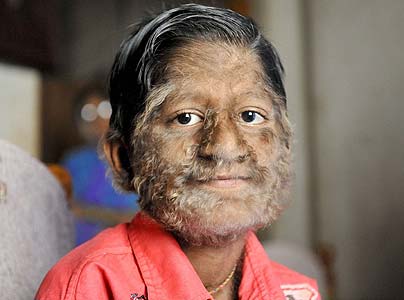 Pruthviraj Patil has suffered from hypertrichosis, a rare genetic condition also known as Werewolf Syndrome, since birth. He is believed to be one of only 50 people in the world with the condition.
Plastic surgeon Vinay Saoji, who has examined Pruthviraj, said that the boy was suffering from one of the rarest genetic conditions.
Pruthviraj’s family have tried a range of treatments - including homeopathy, traditional Indian Ayurvedic remedies and more recently laser surgery – but none has proved successful.

"Hairy nevus, where a person has patches of excess hair growth or hirsutism, is not uncommon. But hair persisting all over the body is very rare," he said
"Though I have seen such cases documented I had never come across anyone suffering from the condition until now.”

The thick matted hair that covers Pruthviraj's face has caused him to be stared at and bullied throughout his childhood, and he rarely leaves his home village in India because of the cruelty of strangers.
When Prithviraj was born villagers told his mother she had given birth to a God. Others thought he was a supernatural creature and a bad omen because of his unique appearance.
"I would like to get the hair removed but even after laser treatment it grows back. The doctors don't have any answers," he said.
Original Post : http://www.telegraph.co.uk/news/newstopics/howaboutthat/1958178/'Werewolf-boy'-begs-for-cure-to-rare-condition.html
Subscribe to:
Posts (Atom)


