There is a new delicacy that is in hot demand in hamlets in Tamil Nadu and Puducherry - protein rich rat meat. It comes cheap, just Rs 2.50 per rat, and villagers swear nothing tastes better.
Snake-hunting Irula tribals, desperate to peddle their rodent-snaring skills, have succeeded in getting the meat on the kitchen menu of villages in Cuddalore district and the Union Territory. The trend could catch on elsewhere too.
Baskar (29) hailing from Melazhunjipettu, Cuddalore district in Tamil Nadu, is hooked to the new found delicacy.
"It (rat meat) tastes so good. I think those who taste it once will start eating it regularly. All our family members eat rat meat now," he said.
Competing with the villagers are the arrack and toddy shop owners. The potent brew and cheap meat are a big hit among villagers. The paddy fields are the tribals’ hunting ground. Each tribal hunter catch about 15 rats a day from the fields and divide their catch among villagers, arrack and toddy shop owners and save a few to take back home.
Original Post : http://timesofindia.indiatimes.com/Heads_and_Tales/Rat_meat_new_delicacy_in_TN_villages/articleshow/3072086.cms
Wednesday, May 28, 2008

Australian town rejects Muslim school
Australian authorities rejected the development of a 1,200-student Islamic school on the outskirts of Sydney on Tuesday, saying it was inappropriate for the small town where anti-Muslim protesters opposed the school.
Camden Council voted against the school being built based on concerns over the impact on traffic flows, loss of agricultural land, but not on religious grounds.
"It is a site issue ... we said all along religious issues, nationalistic issues, will not be entered into," Mayor Chris Patterson told local media.
The school was planned for Muslim students and would have taught the standard Australian education program but also conducted religious classes just as Catholic and Anglican schools in Australia do.
|
|
Why European cos fear Google!
Executives from across Europe's technology, media and telecoms sector fear Internet search and advertising giant Google may steal their business, they told a Reuters summit this week.
Several managers cited the Silicon Valley-based company as one of their most feared rivals -- even if they did not know exactly how Google would become their competitor -- and one they should try to partner with if they knew what was good for them.
More Internet InsightsWhite PapersBuilding an Online Customer Experience Competency: Five Steps The 9 Noble Truths of Custom Experience: Website Wisdom for Everyone in the Organization "I am worried about Google, just because I don't know," Eric Simonsen, chief financial officer of telecoms infrastructure provider Nokia Siemens Networks, told the Reuters Technology, Media and Telecoms Summit in Paris.
"Our vision, with the world connected, primarily over the Internet, 5 billion people, and you look at the economic resources that Google has -- if I think they are not going there, that's a pretty stupid assumption on my part," he said.
"I have no idea how, I have no idea when, but I ought to be thinking about those kinds of things."
Google has branched out from its core businesses into areas as diverse as cellphone software, submarine communications cables and medical software, raising a wave of anxiety that has spread from the United States and is still rising in Europe.
In the US, companies as diverse as retailer Wal-Mart, agricultural commodity supplier Cargill and Wall Street banks have studied how Google could become a major challenger in the long run.
Such seemingly far-fetched concerns have a basis in Google's growing lock on Web search activity -- the starting point for consumers looking for information. Google's market share is more than 70 percent among the major search players in the world.
As a result, Google has come under the glare of competition regulators in Europe and the U.S. in the past year, egged on by Microsoft and major telecommunications carriers.
Original Post : http://infotech.indiatimes.com/News/Internet/Why_European_cos_fear_Google/articleshow/msid-3078757,curpg-1.cms
Several managers cited the Silicon Valley-based company as one of their most feared rivals -- even if they did not know exactly how Google would become their competitor -- and one they should try to partner with if they knew what was good for them.
More Internet InsightsWhite PapersBuilding an Online Customer Experience Competency: Five Steps The 9 Noble Truths of Custom Experience: Website Wisdom for Everyone in the Organization "I am worried about Google, just because I don't know," Eric Simonsen, chief financial officer of telecoms infrastructure provider Nokia Siemens Networks, told the Reuters Technology, Media and Telecoms Summit in Paris.
"Our vision, with the world connected, primarily over the Internet, 5 billion people, and you look at the economic resources that Google has -- if I think they are not going there, that's a pretty stupid assumption on my part," he said.
"I have no idea how, I have no idea when, but I ought to be thinking about those kinds of things."
Google has branched out from its core businesses into areas as diverse as cellphone software, submarine communications cables and medical software, raising a wave of anxiety that has spread from the United States and is still rising in Europe.
In the US, companies as diverse as retailer Wal-Mart, agricultural commodity supplier Cargill and Wall Street banks have studied how Google could become a major challenger in the long run.
Such seemingly far-fetched concerns have a basis in Google's growing lock on Web search activity -- the starting point for consumers looking for information. Google's market share is more than 70 percent among the major search players in the world.
As a result, Google has come under the glare of competition regulators in Europe and the U.S. in the past year, egged on by Microsoft and major telecommunications carriers.
Original Post : http://infotech.indiatimes.com/News/Internet/Why_European_cos_fear_Google/articleshow/msid-3078757,curpg-1.cms
Monday, May 26, 2008
'Werewolf boy' begs for cure to rare condition
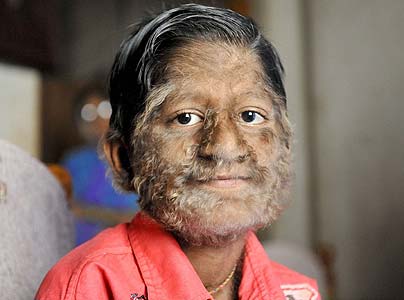 Pruthviraj Patil has suffered from hypertrichosis, a rare genetic condition also known as Werewolf Syndrome, since birth. He is believed to be one of only 50 people in the world with the condition.
Plastic surgeon Vinay Saoji, who has examined Pruthviraj, said that the boy was suffering from one of the rarest genetic conditions.
Pruthviraj’s family have tried a range of treatments - including homeopathy, traditional Indian Ayurvedic remedies and more recently laser surgery – but none has proved successful.

"Hairy nevus, where a person has patches of excess hair growth or hirsutism, is not uncommon. But hair persisting all over the body is very rare," he said
"Though I have seen such cases documented I had never come across anyone suffering from the condition until now.”

The thick matted hair that covers Pruthviraj's face has caused him to be stared at and bullied throughout his childhood, and he rarely leaves his home village in India because of the cruelty of strangers.
When Prithviraj was born villagers told his mother she had given birth to a God. Others thought he was a supernatural creature and a bad omen because of his unique appearance.
"I would like to get the hair removed but even after laser treatment it grows back. The doctors don't have any answers," he said.
Original Post : http://www.telegraph.co.uk/news/newstopics/howaboutthat/1958178/'Werewolf-boy'-begs-for-cure-to-rare-condition.html
Victorian 'supercomputer' is reborn
The world of computing could have been very different to that of today had a machine that was designed over 150 years ago been built at the time.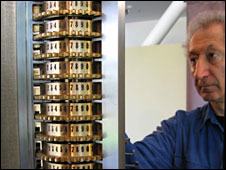
That is the view of Doron Swade, the man who is behind realising the creation of the famed Difference Engine No 2 which has just gone on display in Silicon Valley.
The reason the machine is so highly regarded is because it is seen as the first attempt at automated computing and viewed as something of a missing link in technology history.
Designed by the 19th Century computer pioneer Charles Babbage, the Difference Engine No 2 is a piece of Victorian technology meant to compute mathematical expressions called polynomials and return results to more than 31 digits, knocking the socks off your souped up pocket calculator.
Added to that it has a printer which stamps the results of its calculations on paper and on a plaster tray.
"You can stand in front of this monster of a machine as a Victorian would have done and still have the sense of wonder a Victorian would have had at that time," marvels Mr Swade.
"It takes you back 150 years to a branching point in history and allows you to speculate what might have been had this engine been built."
Personal mission
Regardless of the obvious beauty of the machine, Babbage's vision for it was very practical. To eliminate human error in tabulation.
Everyone from financiers to scientists and from engineers to astronomers "relied on printed mathematical tables and the fear was that these tables were riddled with errors because they were produced by humans and by hand," explains Mr Swade.
Original Post : http://news.bbc.co.uk/2/hi/technology/7391593.stm
The two Islams
 In the third of four edited excerpts from his new book, Chasing a Mirage, Tarek Fatah discusses the two streams of Islam Muslims have brought to the world -- one peaceful and the other militant.
In August, 1990, 45 representatives from Muslim countries, under the auspices of the Organization of the Islamic Conference, signed the Cairo Declaration on Human Rights in Islam. The result leaves much to be desired. Although successive Islamic declarations on human rights have tried to present themselves as compatible with the principle of universal basic rights, a number of severe contradictions exist between these declarations and Western constitutionalism. The most important is that Islam does not accept separating religion from the state and societal affairs. According to Articles 23 and 24 of the Cairo Declaration of Human Rights in Islam, all rights and freedoms are subject to Islamic sharia. In this framework, human rights lose their unconditional character and their focus on the protection of the individual vis-a-vis any kind of power.
Hence, within Islamic states there is an unavoidable blurring of religious and political authority, which has an important impact on the implementation and interpretation of human rights. Consider Morocco, for example. It is a relatively secular state, yet Morocco's King Hassan presents himself as a direct descendent of the Prophet. In Iran the role of Islam in defining the state is made clear in its constitution. Article 2 stipulates that "The Islamic Republic is a system based on belief in: The One God, His exclusive sovereignty and right to legislate, and the necessity of submission to His commands..."
In the same spirit, the majority of the Arab constitutions declare sharia as the basis of legislation, or at least consider it as a main source of legislation. This legitimizes the notion of racial and religious superiority, and allows for multiple levels of citizenship and widespread and systemic discrimination against racial and religious minorities living within a state's borders. Invariably, the human rights of the weak and dispossessed, the minorities and women, the disabled and the heretics, are trampled upon without the slightest sense of guilt or wrongdoing. Men and women are imprisoned, routinely tortured and often killed, while numbed citizens, fearful of offending Islam, unsure about their own rights, insecure about their own identities, allow these violations to continue.
By looking the other way, the intelligentsia and middle classes have become complicit in these crimes. They justify their inaction as patriotism, where they stand in solidarity with the Islamic State, with the misguided idea that those who fight for universal human rights are somehow working for Western imperialism or represent the interests of Judeo-Christian civilization.
One could say there are two Islams that Muslims have introduced to the world. One, peaceful, spiritual and deeply respectful of the "other," an Islam that relied on the Quranic expression, "To you your religion, to me mine." It is this Islam that today makes Indonesia the world's largest Muslim nation with 250 million people.
Tells girls to wear loose swimwear, stay underwater
Islam no excuse to miss swimming: Germany
A German court has ordered a 12-year-old Muslim schoolgirl to attend co-ed swimming lessons, despite the objection of her parents, press reports said on Thursday.
The girl's parents had filed a case citing Islamic prohibitions against tight-fitting clothing worn in front of members of the opposite sex, Germany's public broadcaster Deutsche Welle (DW) said.
But the court in Düsseldorf ruled on Wednesday that the state's responsibility to educate the girl trumped her right to religious freedom.
In its ruling, the court said her religious beliefs could be protected if she chose loose-fitting swimwear and remained in the water throughout the lesson.
The Alexander von Humboldt school in Remscheid, a city of 118,000 people in the western state of North Rhine-Westphalia, said it did not have the staff to separate boys and girls during swimming lessons.
The parents' attorney said the family plans to appeal and that the decision, DW reported.
A German court has ordered a 12-year-old Muslim schoolgirl to attend co-ed swimming lessons, despite the objection of her parents, press reports said on Thursday.
The girl's parents had filed a case citing Islamic prohibitions against tight-fitting clothing worn in front of members of the opposite sex, Germany's public broadcaster Deutsche Welle (DW) said.
But the court in Düsseldorf ruled on Wednesday that the state's responsibility to educate the girl trumped her right to religious freedom.
In its ruling, the court said her religious beliefs could be protected if she chose loose-fitting swimwear and remained in the water throughout the lesson.
The Alexander von Humboldt school in Remscheid, a city of 118,000 people in the western state of North Rhine-Westphalia, said it did not have the staff to separate boys and girls during swimming lessons.
The parents' attorney said the family plans to appeal and that the decision, DW reported.
Indians are world`s greenest consumers
 Consumers in India care the most for the environment in terms of their day-to-day behaviour with those in the us coming at the bottom, according to National Geographic.
As per a study of 14 countries conducted by National Geographic Society, India and Brazil have come at the top, jointly.
"This first-of-its-kind study reveals surprising differences between consumers in developed and developing countries in terms of environmentally friendly actions," Nat Geo said.
The survey was conducted online earlier this year among 14,000 consumers in Australia, Brazil, Canada, China, France, Germany, Great Britain, Hungary, India, Japan, Mexico, Russia, Spain and the United States.
However, while Indian consumers (along with Brazilians) outranked others on the 'Greendex' survey of environmentally sustainable behaviour, they came in last on a short quiz of environmental knowledge, correctly answering on average only two of the six questions posed.
Indian and Brazilian consumers topped the 14-country index, and have the highest Greendex score for environmentally sustainable consumption at 60 points each, because of their relatively lower environmental impact from housing and above-average performance on transportation and food.
Original Link : http://www.zeenews.com/articles.asp?aid=441868&sid=ENV
Sunday, May 25, 2008
Man sentenced to die for insulting God and Prophet
 A Turkish barber who was sentenced to death by a Jeddah court on charges of blasphemy will have his case heard in an Appeals Court in Mecca next week, press reports said.
Sabri Bogday was sentenced to die after two men told authorities that he had sworn at God and the Prophet Muhammad (PBUH) at his barbershop in Jeddah early last year, Saudi's English-language daily Arab News reported.
Bogday admitted to his crime at Jeddah General Court last June and did not challenge the men's testimonies. But at the final court hearing, he denied that he swore at God and the Prophet. He was sentenced to die on March 31.
| |
Indian child opts for rich father
 An 11-year-old Indian child, asked to choose between his parents engaged in a bitter custody battle, has picked his father because he is more affluent.
The child, who cannot be named for legal reasons, told the judges he loved both the parents equally, but wanted to live with his father.
The Mumbai court ruled in favour of the father after hearing the boy.
The court said it was sending the child to stay with the father because it was convinced of the child's maturity.
Under Indian law, the custody of children under the age of five is given to the mother except in exceptional circumstances.
The courts have often taken the view that a child under 10 needs to stay with the mother.
Once a child turns 10, its normal practice for the court to take the wishes of the child into account while deciding on custody.
Original Post : http://news.bbc.co.uk/2/hi/south_asia/7404788.stm
Parents forget kid at airport, fly away
A newly arrived family from the Philippines here did forget their two-year-old son while catching a connecting flight to Winnipeg on Monday.
Since domestic flights in Canada don't allow heavy handbags on international flights, the family - comprising the parents and grandparents of the boy - were forced by Air Canada staff at Vancouver international airport to re-arrange their bag weight.
Having lost a lot of time in re-packing, the family got late in catching the connecting flight to Winnipeg.
In their confusion, they left the toddler behind.
As they ran separately to catch the flight, the parents thought the boy was with his grandparents. The grandparents thought he was with his parents.
This was not detected even when they boarded the plane as the family members were seated separately.
The babbling little boy was found wandering in the departure lounge and then the airport staff searched for his parents.
They brought a Tagalog-speaking airport agent to understand what the boy was saying. Finally, his family was tracked down to Winnipeg.
But by that time, they had landed in Winnipeg. They too realized that the boy was missing only when they came out of the plane.
Air Canada caught hold of the father and flew him back to Vancouver free of cost to pick up his son.
Kenya mob burns 11 "witches" to death
Burnt alive in their homes
A mob tied up at least 11 people accused of witchcraft and burnt them to death in a remote village in western Kenya, police said Wednesday.
Police were on patrol in the village of Nyakeo to prevent revenge attacks after eight women and three men, 10 of them aged between 70 and 90, were lynched and burnt to death on Tuesday, spokesman Charles Owino said.
"Their houses were torched. Eight women and three men suspected of being witches died," Kenya's deputy police spokesman Charles Owino said.
Kisii district residents confirmed the killings, saying an enraged crowd had gone house-to-house on Tuesday night, using a list of supposed witches in the region.
Original Post : http://www.alarabiya.net/articles/2008/05/21/50202.html
A mob tied up at least 11 people accused of witchcraft and burnt them to death in a remote village in western Kenya, police said Wednesday.
Police were on patrol in the village of Nyakeo to prevent revenge attacks after eight women and three men, 10 of them aged between 70 and 90, were lynched and burnt to death on Tuesday, spokesman Charles Owino said.
"Their houses were torched. Eight women and three men suspected of being witches died," Kenya's deputy police spokesman Charles Owino said.
Kisii district residents confirmed the killings, saying an enraged crowd had gone house-to-house on Tuesday night, using a list of supposed witches in the region.
Original Post : http://www.alarabiya.net/articles/2008/
Poverty pushes women into world’s oldest profession
 When 19-year-old Fatima returned to her home in northern Afghanistan after years as a refugee in Iran, she struggled desperately to earn a living.
She briefly found work with an NGO, before being let go, and then spent two months learning how to weave carpets, before the factory shut down and she was again out on the streets of Mazar-i-Sharif.
Determined to support her mother, two sisters and young brother, she turned to a profession that has long been practised the world over but remains deeply suppressed in conservative Afghanistan -- prostitution.
"I had no other way but prostitution," says the pretty teenager, dressed in tight blue jeans with a black veil pulled loosely over her head.
Sometimes charging $50 a time, her work is illegal and would bring shame on her family if discovered, but it provides a lifeline she otherwise could not have imagined.
And there is anecdotal evidence, supported by doctors concerned about the potential for the spread of HIV and AIDS, that more and more young women across northern regions of Afghanistan are turning to sex work to escape grinding poverty.
Easy access
For clients, paying for sex gives them easy access to women that they otherwise would not be able to meet or could only have contact with if they were married -- a costly exercise in itself.
"I have sex at least once a week with one of these prostitutes," said Zilgy, a 25-year-old visiting a brothel in Mazar-i-Sharif. "I am their regular customer now. I have their telephone numbers and invite them to many places."
Ahmad Jamshid, aged 27, says he has sex with prostitutes because he cannot afford a wife.
"I am a shopkeeper. If I want to marry a girl, I must have at least $20,000 to marry her. Having sex with a prostitute is the only way that can I meet my expectations," he said.
Original Link :http://www.alarabiya.net/articles/2008/
Aging: Smoking, Drinking and Alzheimer’s Risk

People who are on a path to develop Alzheimer’s disease may hasten its arrival if they drink or smoke too much, researchers say.
The researchers looked at the most common form of the illness, late-onset Alzheimer’s, which doctors believe may be touched off by a variety of factors, separately or together.
For this study, presented at a recent conference of the American Academy of Neurology, the researchers looked at three possible contributors: alcohol, tobacco and a gene called APOE. The researchers examined over 900 people considered to have possible or probable Alzheimer’s disease, asking family members about their smoking and drinking histories and testing them for the gene.
The researchers looked at the most common form of the illness, late-onset Alzheimer’s, which doctors believe may be touched off by a variety of factors, separately or together.
For this study, presented at a recent conference of the American Academy of Neurology, the researchers looked at three possible contributors: alcohol, tobacco and a gene called APOE. The researchers examined over 900 people considered to have possible or probable Alzheimer’s disease, asking family members about their smoking and drinking histories and testing them for the gene.
German parents offer baby on eBay for 1 euro
 A number of people called authorities across Germany after seeing the offer on eBay that read: "Baby -- collection only. Offer my nearly new baby for sale because it cries too much. Male, 70 cm long."
The opening bid was 1 euro ($1.57). There were no bidders during the two hours before the offer was removed.
Renee Beck, a police spokesman in the Bavarian town of Krumbach west of Munich, said on Saturday the 23-year-old woman told them it was only a joke.
Original Post : http://www.alarabiya.net/articles/2008/
Kerala temple underwear ruling
Nearly 200 staff at a Hindu temple in southern India have won the right to wear underwear to work.
The human rights commission in Kerala state has ordered Sabarimala temple to withdraw a dress code that barred staff from wearing underwear.
The dress code was imposed 10 years ago after several cases of theft.
Sabarimala is the second busiest temple in southern India after Tirupati, visited by nearly 50 million people during the special pilgrimage season.
Original Post : http://news.bbc.co.uk/2/hi/south_asia/7
Subscribe to:
Posts (Atom)


